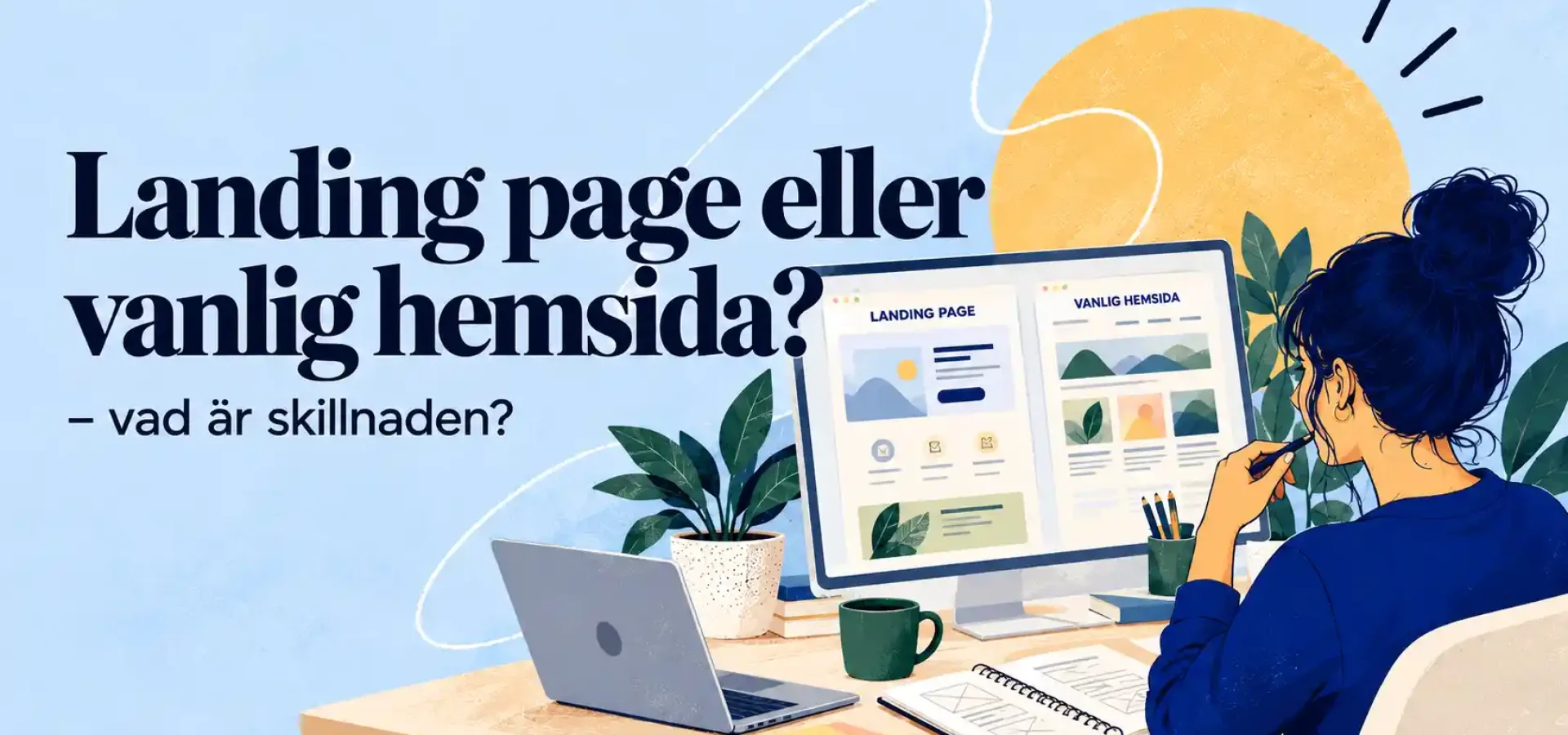
One landing page, or a landing page, and a standard website may look quite similar at first glance. Both may contain images, text, buttons and contact details.
The difference lies primarily in the purpose.
A standard website should present the company as a whole and help visitors find information on, for example, services, the company itself, contact details and references.
A landing page, on the other hand, is usually designed to a specific objective.
This could involve getting the visitor to book an appointment, buy a product, fill in a form or sign up for an offer.
So which one does your business need?
It depends on what you want the visitor to do.
What is a landing page?
A landing page is a page designed around a clear message and clear action.
Visitors often arrive at the page from, for example:
- a Google advert
- a newsletter
- Instagram or Facebook
- a campaign
- a QR code
- a specific link
Rather than offering visitors a wide range of options, the page aims to guide them towards a single goal.
These could include, for example:
Book a meeting
Request a quote
Buy now
Download the guide
Sign up
That is why landing pages are often simpler and more focused than standard websites.
What does a good landing page look like?
A good landing page doesn’t have to be long or complicated.
The most important thing is that it quickly becomes clear:
- what you offer
- who the offer is for
- what problem you’re solving
- why customers should choose you
- what the visitor should do next
The page often begins with a clear heading, a short introduction and a CTA button.
You can then explain the offer in more detail, highlight the benefits, provide customer testimonials and finish with another clear call to action.
The less a visitor has to think about what the next step is, the better.
A landing page has fewer distractions
On a standard website, you want people to be able to find out more about the company.
That is why there is often a menu with links to several pages.
A landing page works differently.
Here, you generally want to prevent visitors from clicking away before they have done what you want the page to lead them to do.
Therefore, a landing page may include:
- easier navigation
- fewer links
- a clear proposition
- a recurring CTA
- fewer elections
That doesn’t mean the page should feel empty.
It just needs to be more focused.
What is a typical company website?
A typical company website covers a wider range of topics.
It is intended to help the customer understand:
- who the company is
- what services or products are offered
- how the company operates
- previous projects or references
- how the customer comes into contact with the company
A company website therefore often consists of several pages.
For example:
- Home
- Services
- Portfolio
- About Us
- Blog
- Contact
For many small businesses, the website is the central hub of their entire digital presence.
Social media, Google and adverts can then lead people back to it.
Landing page or website – which should you choose?
It doesn’t have to be one or the other.
A standard website serves as the company’s long-term digital base.
A landing page can then be used for specific campaigns or offers.
A company can therefore have a standard website and several different landing pages.
It’s often a very good combination.
When is a landing page most appropriate?
A landing page is particularly well suited when you’re working on a specific campaign.
This might be the case, for example, when you:
- is launching a new service
- advertises on Google
- run a Meta campaign
- sells a specific product
- offers a free consultation
- collects leads
- promote an event
- has a limited-time offer
If someone clicks on an advert for a specific service, it is often better for them to be taken directly to a page about that particular service rather than to the company’s standard homepage.
Example: a campaign for a service
Imagine a hairdressing salon wants to promote balayage.
If the advert links to the salon’s standard website, the customer will have to search for the right treatment, price and booking details themselves.
A landing page could instead display the following directly:
Balayage – book your consultation
The page may also include before-and-after photos, information about the treatment, frequently asked questions and a booking button.
It creates a much clearer path for the customer.
When is a standard website better?
A standard website is better when you want to showcase the whole company.
It works particularly well when a customer needs to compare several services or wants to find out more before getting in touch with you.
A website also helps to build a company’s credibility over time.
You can work with:
- SEO
- blog
- references
- portfolio
- service pages
- information about the company
This means that your website can continue to help customers find you long after a campaign has ended.
Landing pages and adverts
Landing pages are often used in conjunction with digital advertising.
For example, if you are advertising:
Web design for small businesses
Ideally, the link should lead to a page that deals specifically with web design.
Not to a general home page with several different services.
The better the page matches the advert’s message, the easier it will be for the visitor to understand what you’re offering.
What does ‘conversion’ mean?
When we talk about landing pages, the word is often used conversion.
Quite simply, it means that the visitor does what you want them to do.
It could be that:
- book a meeting
- fill in a form
- buy something
- call
- download something
- register
A landing page is therefore often more conversion-focused than a standard website.
Mobile optimisation is particularly important
Many people view adverts and social media directly on their mobiles.
That is why a landing page needs to work just as well on a small screen as it does on a computer.
The heading should be clear.
The text should be easy to read.
The buttons should be easy to press.
Filling in the form shouldn’t feel like a chore.
A stylish desktop design isn’t much use if the site is difficult to use on a mobile.
A clear CTA makes a big difference
CTA stands for Call to Action.
That is the action you want the customer to take.
Good CTA copy is often specific.
For example:
Book a meeting
Request a quote
See our packages
Contact us
Start your project
Please try to avoid vague buttons that simply say “Click here”.
The visitor should understand what happens when they click.
Do all businesses need a landing page?
No.
A small business that doesn’t run marketing campaigns can get by perfectly well with a well-designed, standard website.
However, as soon as you start promoting a specific offer, a separate landing page can be very useful.
It can help to create a clearer message and a simpler path from advert to action.
Summary – landing page or standard website?
One standard website presents the company as a whole.
One landing page focuses on a specific offering or objective.
A standard website is best suited for a long-term online presence, SEO, services and information.
Landing pages are best suited to campaigns, adverts, product launches and conversion.
For many companies, therefore, the best solution is not to choose between them.
It’s about using both correctly.
At Svea Designs we work on web design and WordPress for small businesses and can create both comprehensive company websites and targeted landing pages tailored to the company’s objectives.

 Swedish
 English
 Spanish