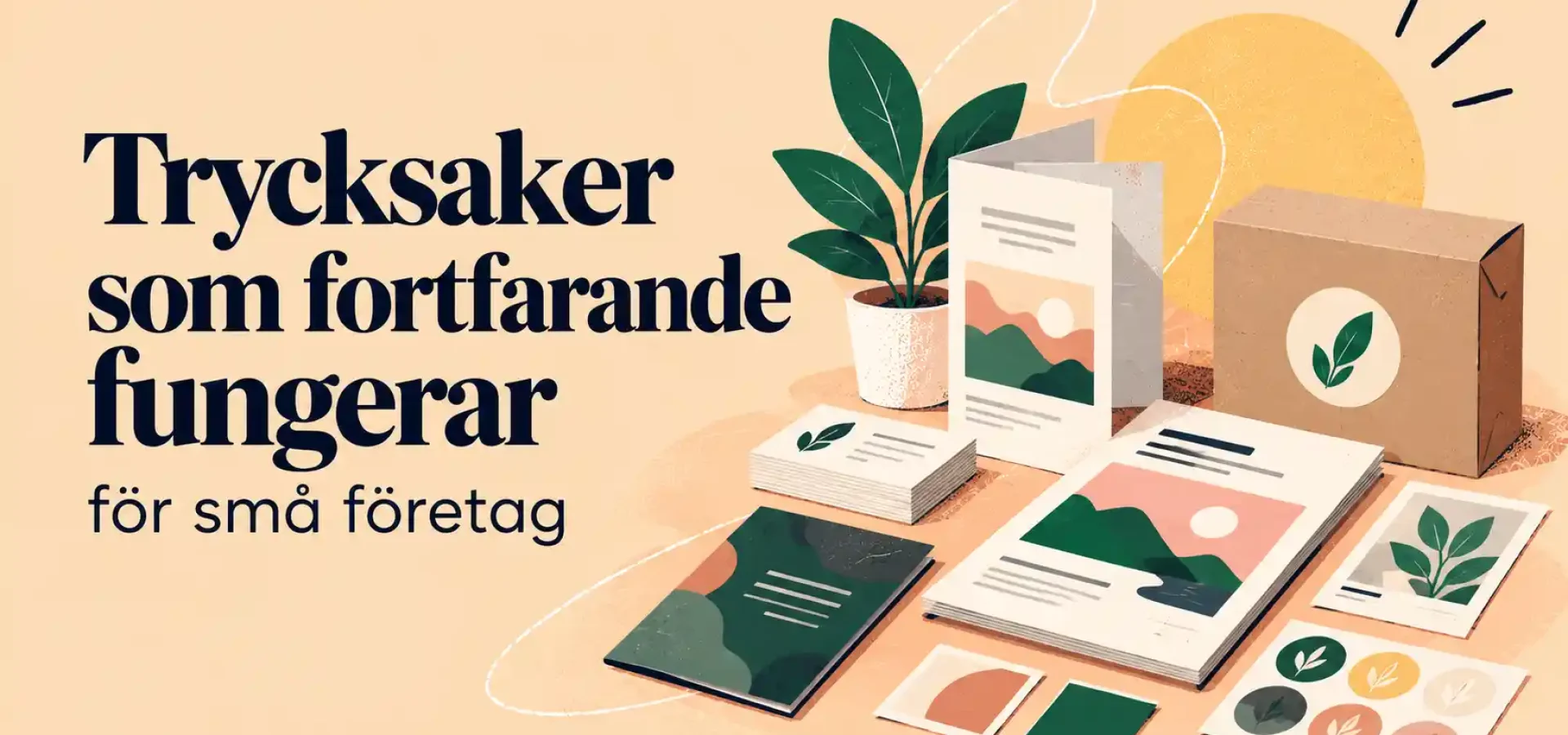
Digital marketing has become an integral part of almost every company’s communications. But that does not mean that printed materials have had their day.
On the contrary, well-designed printed materials can still make a strong impression, particularly when used in the right context and alongside a clear visual brand identity.
For small businesses, printed materials can be a simple way to appear more professional, make a lasting impression and create a clearer connection between the digital and physical worlds.
Here, we look at which printed materials are still effective and when it might be worth using them.
Business cards are still useful
Business cards are perhaps the most classic printed item of all.
Even though almost all contact details are available digitally, a well-designed business card can still feel personal and professional.
It works particularly well for:
- meetings
- trade fairs
- networking events
- customer visits
- local events
A good business card doesn’t need to contain a lot of information.
Often, it’s enough to:
- name
- company
- phone number
- website
- any QR code
The most important thing is that the design is clear and in line with the company’s visual identity.
Flyers are great when the message is simple
Flyers are still effective when you want to communicate a clear offer or a specific service.
They are particularly well suited to local businesses.
For example:
- salons
- restaurants
- shops
- craftsman
- event
- associations
- smaller campaigns
A leaflet needs to be easy to understand.
Visitors should be able to see at a glance:
- what you offer
- why it is relevant
- how to contact you
- what the next step is
Too much text often means the message gets lost.
Brochures are a good source of further information
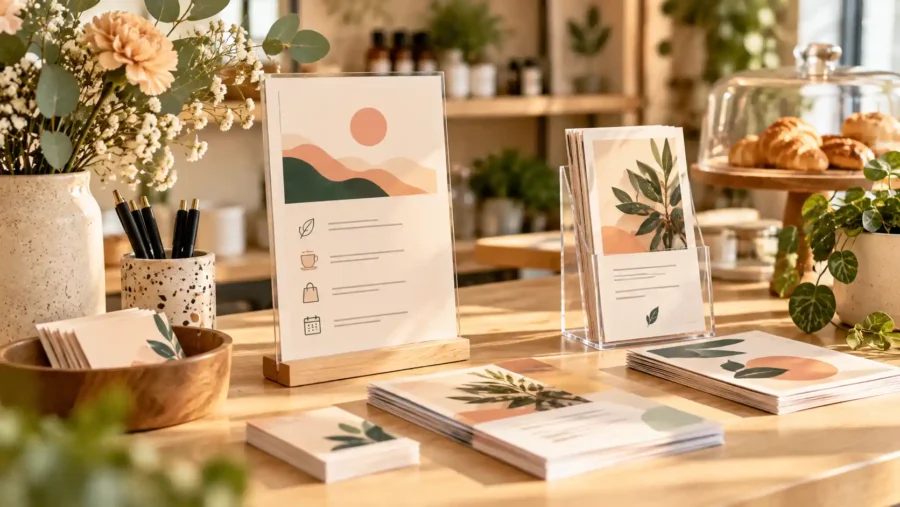
When a flyer isn’t enough, a leaflet may be a better option.
Leaflets are ideal when you need to explain several services or provide more information about the company.
This may be useful for:
- hotel
- property company
- construction company
- health and beauty
- education
- consultancy services
- travel company
A good leaflet should be easy to skim through.
Use clear headings, short paragraphs and images that help the reader understand the content.
Product leaflets are still effective
Product sheets are particularly effective for companies that sell products or technical solutions.
They can be used by sales staff, at trade fairs or sent with quotations.
A product sheet may contain:
- product name
- brief description
- advantages
- specifications
- pictures
- price
- contact details
It is important that the layout is clear.
Product sheets should help customers understand the product quickly; they should not feel like a technical manual.
Leaflets are useful when you want to tell people more
A leaflet offers more space than a standard flyer, yet still feels simple and compact.
It can be used to:
- introduce the company
- describe services
- show a process
- announce the prizes
- gather important information
For small businesses, a leaflet can be a good option if you want something that feels more polished but is still easy to hand out.
Posters are effective when they are displayed in the right place
Posters can still be very effective.
But they need to be used in the right environment.
They work particularly well for:
- event
- campaigns
- local offers
- shops
- restaurants
- sports facilities
- cultural activities
A good poster should be understandable in a matter of seconds.
It must therefore have:
- a clear heading
- a striking image or graphic
- short message
- clear call to action
Menus are still important printed materials
For restaurants, cafés and salons, menus and price lists are still very relevant.
They form part of the customer experience.
A well-designed menu can help to:
- highlight premium options
- make information easier to find
- strengthen the brand
- create a more professional feel
The design should be easy to read and display correctly in the appropriate format.
Packaging is part of the brand
Packaging is also a form of printed communication.
They can play a major role in how a brand is perceived.
This applies in particular in the following areas:
- food
- beauty
- fashion
- e-commerce
- presents
- crafts
Well-designed packaging can make a product more memorable.
These may include labels, cardboard boxes, stickers or tissue paper.
Stickers are small but effective
Stickers are simple but still work well.
They can be used on:
- package
- bags
- bottles
- envelope
- giveaways
- exhibition materials
They are cheap to produce and can help build brand recognition.
For small businesses, they are a simple way to incorporate more branding into day-to-day operations.
Printing on clothing and promotional products
Print doesn’t have to be limited to paper.
T-shirts, caps, cloth bags and workwear can also serve as marketing tools.
It is particularly well suited to:
- event
- trade fairs
- staff
- shops
- creative businesses
- associations
When the design is clear, promotional products can help strengthen the brand even outside the company’s usual channels.
QR codes make printed materials more digital
A good printed publication does not have to be entirely analogue.
QR codes can create a simple link between print and digital content.
They can be used to bring about:
- website
- booking
- menu
- contact form
- campaign
- social media
- reviews
This makes the printed material more interactive and easier to follow up on.
When are printed materials most effective?
Printed materials work best when they have a clear purpose.
It’s rarely a good idea to print material just for the sake of “having something”.
Instead, consider the following:
- Who should receive the material?
- Where is it to be used?
- What message should it convey?
- What do you want that person to do afterwards?
When the objective is clear, it also becomes easier to choose the right format.
The design must be consistent with the brand
Printed materials should not feel like something completely separate from the rest of the company.
Colours, typography, images and graphic elements should adhere to the same visual identity as:
- the website
- social media
- presentations
- advertisements
- packaging
This creates a more professional and cohesive experience.
Quality makes a big difference
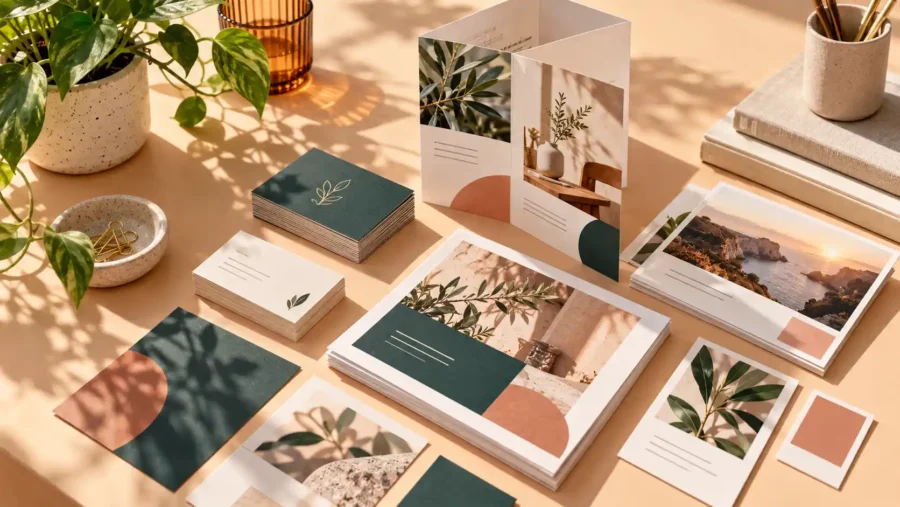
The choice of paper, print quality and finish all affect how the material is perceived.
A simple business card can feel exclusive with the right paper and a well-thought-out design.
Similarly, an attractive layout can lose a lot of its impact if the print feels flimsy or cheap.
That is why it is important to consider both design and production.
Printed materials do not need to replace digital marketing
Printed materials and digital marketing work best together.
A flyer, for example, can link to a campaign page.
A business card can include a QR code for LinkedIn.
A leaflet can supplement the information on the website.
So it’s not a question of print or digital.
It’s all about using the right channel at the right time.
Summary
Printed materials are still effective when used for a specific purpose.
Business cards, leaflets, brochures, product sheets, posters, packaging and promotional items can still add significant value for small businesses.
The most important thing is that the material is easy to understand, visually consistent and relevant to the target audience.
When print and digital communication work together, the result can be both more professional and more memorable.
Find out more about our services
Would you like to create printed materials that reflect your brand and work in the real world? Find out more about our services in print & profile and graphic design and how Svea Designs can help you produce materials that come across as clear, professional and well thought-out.

 Swedish
 English
 Spanish