
For small businesses, the website is often one of the most important elements of their brand. It is where customers look for information, compare services, book appointments and decide whether the business comes across as professional and trustworthy.
WordPress is one of the most common tools for building websites and is particularly well suited to small businesses looking for a flexible solution that can be developed over time.
With WordPress, you can create anything from a simple business page to a larger website featuring a blog, booking system, forms, an online shop and other features.
Here, we’ll look at why WordPress can be a good choice for small businesses and what you need to bear in mind before building your website.
What is WordPress?
WordPress is a content management system, often referred to as a CMS.
This means you can create and manage content on a website without having to programme each page from scratch.
Among other things, you could work on:
- pages
- blog post
- pictures
- menus
- form
- products
- bookings
- SEO
- user
This makes WordPress flexible for businesses that want to be able to update their website themselves.
Why is WordPress suitable for small businesses?
One of the biggest advantages is flexibility.
You can start with a relatively simple website and then expand it as the business grows.
It could, for example, begin with:
- home page
- About us
- services
- contact
You can add the following later:
- blog
- booking system
- newsletter
- customer portal
- online shop
- several languages
This means you don’t need to rebuild the entire website every time your business changes.
1. You have more control over your website
With your own WordPress installation, you have greater control over your website than you would on many completely closed platforms.
You can choose for yourself:
- web hosting
- domain
- theme
- plugins
- design
- features
This is a major advantage if you want to be able to develop the website in the long term.
2. WordPress can be customised to suit your brand
A website shouldn’t just work well.
It should also feel like your own business.
With WordPress, you can create a design that perfectly reflects your visual identity:
- colours
- typography
- pictures
- illustrations
- icons
- layout
This makes it possible to create something more personalised than a standard template that looks just like many other websites.
3. You can update the content yourself
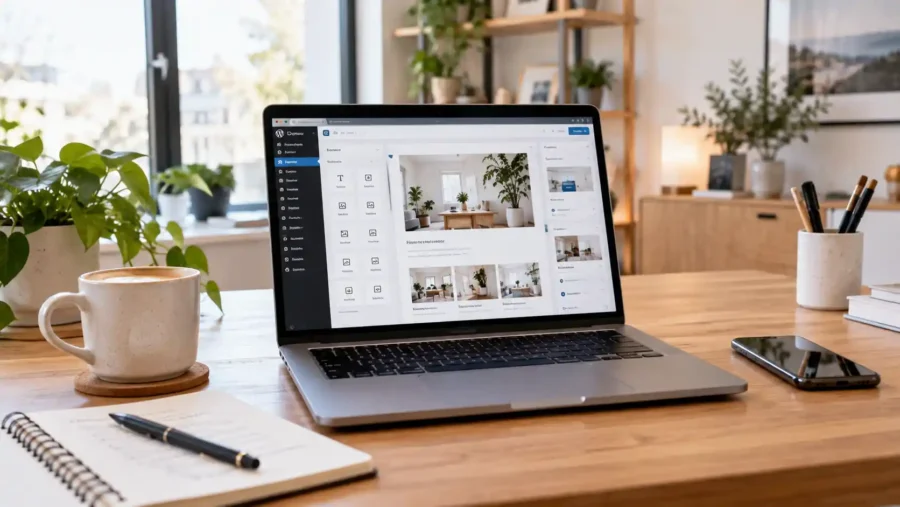
For a small business, it is often important to be able to make minor changes without having to contact a developer every time.
In WordPress, you can:
- change text
- add images
- publish a blog post
- update prices
- change opening hours
- add new services
It saves both time and money.
At the same time, it’s a good idea to have a clear structure so that the website doesn’t become cluttered after numerous updates.
4. WordPress works well for SEO
WordPress offers excellent opportunities for search engine optimisation.
You can optimise:
- page titles
- meta descriptions
- headings
- alt text for images
- internal links
- URL structure
- blog content
With the right structure, it becomes easier for Google to understand what the website is about.
That doesn’t mean that WordPress automatically provides good SEO, but it does give you good tools to work with.
5. The blog is built in from the outset
WordPress started out as a blogging platform and therefore has a robust content management system.
For small businesses, a blog can be a good way to:
- answer frequently asked questions
- demonstrate knowledge
- work on SEO
- create content for social media
- build trust
What’s more, a blog post can continue to drive traffic long after it has been published.
6. There are plugins available for many functions
Plugins are add-ons that give WordPress more features.
For example, you can add:
- contact form
- booking
- security
- SEO
- cache
- online shop
- membership
- newsletter
- cookie management
That makes WordPress very flexible.
However, it is important not to install too many plugins.
Too many plugins, or poorly maintained ones, can slow down the website or cause security issues.
7. WordPress works for both service providers and online shops
WordPress is suitable for many different types of small businesses.
It might work for:
- consultants
- designers
- hairdressers
- therapists
- craftsman
- restaurants
- photographers
- shops
- coaches
With WooCommerce, WordPress can also be used for e-commerce.
This means that the same platform can be used for both a simple service website and a larger online shop.
8. Mobile optimisation is crucial
A WordPress website needs to work well on mobile devices.
It’s not enough for it to look good on a computer.
The mobile version must have:
- clear buttons
- easy-to-read text
- easy navigation
- a good distance
- the correct image sizes
- fast charging
Many visitors will find your business directly via their mobile phones, so the user experience on mobile is particularly important.
9. Speed affects the experience
A slow website can cause visitors to leave before the page has finished loading.
That is why a WordPress website needs to be optimised.
This may include:
- compressed images
- good web hosting
- cache
- avoid unnecessary plugins
- optimised code
- the correct image format
A fast website feels more professional and is easier to use.
10. Security and updates are important
WordPress needs to be maintained.
This means you need to update:
- WordPress
- theme
- plugins
You will also need:
- backups
- strong passwords
- SSL certificate
- security plugin, if required
It might sound a bit technical, but with the right structure, it’s easy to manage.
The important thing is not to leave the website without updates for a long time.
WordPress.com or your own WordPress installation?
There are various ways to use WordPress.
WordPress.com is a more fully-fledged service where a lot is taken care of for you.
Having your own WordPress installation via a web hosting provider gives you greater control and more options.
For businesses that want to be able to customise the design and features more freely, a dedicated WordPress installation is often the most flexible option.
Which solution is best for you depends on how much control you want and how much you want to develop the website.
Do small businesses really need a large website?
No.
A good website doesn’t necessarily need to have lots of pages.
For many small businesses, the following goes a long way:
- home page
- services
- About the company
- contact
The most important thing is that the content is clear and that visitors understand it straight away:
- what you offer
- who the service is intended for
- why they should choose you
- how they contact you
A smaller, well-designed website is often better than a large website with unnecessary content.
When is WordPress a good choice?
WordPress is particularly well suited if you:
- wants to be able to update the website themselves
- wants to be able to develop the website over time
- need a blog
- wants to work in SEO
- want to be able to add features later
- wants greater control over the design
It is therefore a good choice for businesses looking for flexibility.
Summary
WordPress for small businesses is a flexible solution that can be tailored to suit both the business and the brand.
You can start off simply and build on that over time.
With the right design, structure and maintenance, WordPress can become a long-term platform for a company’s website, blog and digital marketing.
The most important thing is not to use as many functions as possible.
The most important thing is to build a website that is clear, fast, user-friendly and relevant to customers.
Find out more about our services
Would you like to create a professional WordPress website for your business? Find out more about our services in web design and how Svea Designs can help you build a clear, user-friendly and personalised website.

 Swedish
 English
 Spanish